Experimental Investigation of Electric Fields for Dust Removal on Solar Panels for Mars Rovers
Project Overview
As a team member on a vertically integrated project (VIP) at Georgia Tech, I worked alongside interdisciplinary students to conduct experiments on improving dust mitigation techniques for Mars rovers. Since dust storms pose a threat to a rover’s ability to generate power and can be hazardous to any critical rover component, our team investigated new solutions to mitigate dust accumulation. After conducting research on preexisting dust mitigation methods and their rates of success, the team designed a successful experiment that generated an electric field removing Martian regolith dust particles of various sizes from ITO-coated glass panels. The regolith particles were created in the lab and closely resemble the composition of real Martian regolith. These particles were then filtered based on size and uniformly applied to the glass panels. Running the generated field over these panels resulted in successful dust removal.

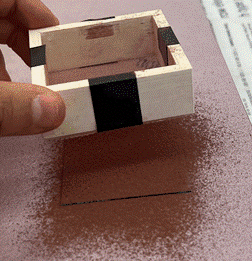
An example of how we created a 400 μm filter to uniformly distribute particles on the glass panels.
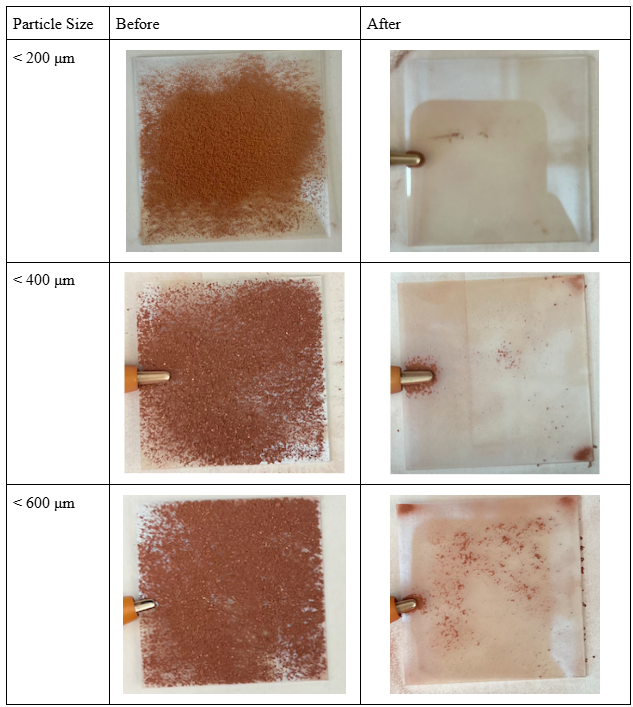
Results for various dust particle sizes.
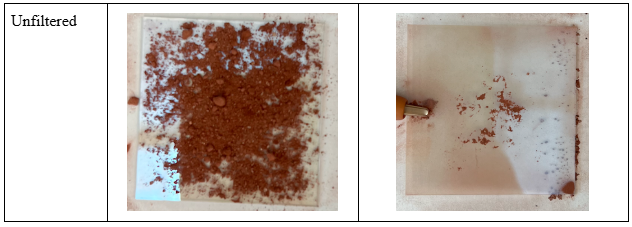
Results for unfiltered dust particles.
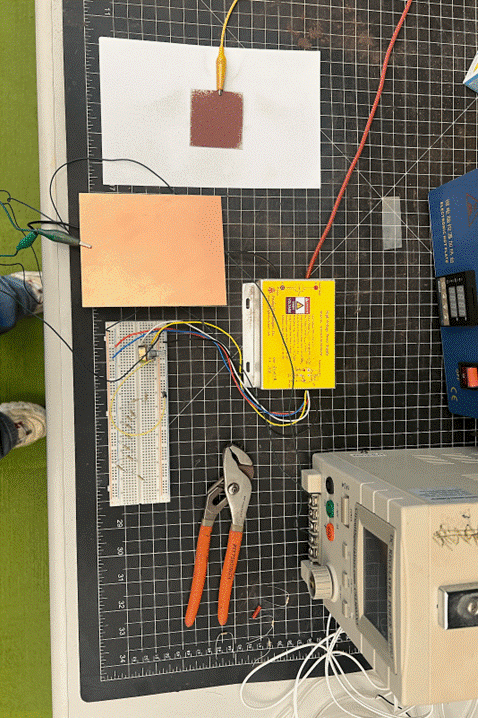
The full experimental setup.
A run of the experiment where it is clear the electric field successfully removes the majority of particles within a few passes.
Additional Details
Non-pictured Steps
- Additional information can be found in the group's report here.